
S1 Self-esteem
H
You usually keep a steady sense of self-worth even when life gets noisy.
SBTI Type
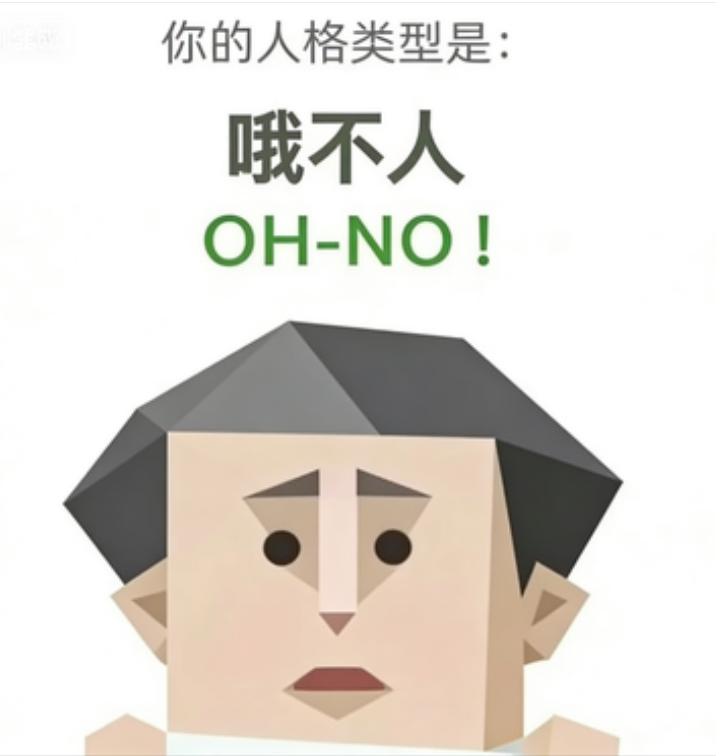
The Alarmist · 哦不人
You can see six disasters ahead from one badly placed cup.
OH-NO types are cautious, boundary-aware, and tuned to risk. You do not panic for fun; you simply notice how quickly things can go sideways.
Want to see your own result? Take the free SBTI test — it only takes a few minutes.
Take the testEach normal type is defined by a 15-dimension pattern. The cards below show the baseline temperament behind this result.
You usually keep a steady sense of self-worth even when life gets noisy.
You have a clear read on your motives, limits, and desires.
Comfort and safety often rank above ambition in your inner system.
Your internal alarm goes off fast in close relationships.
You can invest deeply, but you still keep one hand on the brake.
Personal space stays important even when feelings are real.
Your default mode is suspicion first, warmth later.
Order gives you a sense of calm, and structure feels natural.
You like knowing what direction your life is heading in.
Progress, gain, and momentum tend to light you up.
You tend to choose quickly and do not love dragging decisions out.
You can execute, but your consistency depends on timing and mood.
Starting social contact usually costs you a noticeable amount of energy.
Your boundary line is real, and people usually feel it.
You are usually straightforward about what you think and feel.
The most common questions people search for about the SBTI OH-NO type.
OH-NO types are cautious, boundary-aware, and tuned to risk. You do not panic for fun; you simply notice how quickly things can go sideways.
You can see six disasters ahead from one badly placed cup.
Take the free 31-question SBTI test on this site. The algorithm scores your answers across 15 behavioral dimensions and matches your profile against every named type. If OH-NO is your closest match, it becomes your result.
SBTI does not publish official distribution data, so there is no verified answer on how rare OH-NO is. What matters is that every named SBTI type — including OH-NO — describes a real and distinct behavioral pattern. No result is objectively better, worse, or rarer than another.