
S1 Self-esteem
H
You usually keep a steady sense of self-worth even when life gets noisy.
SBTI Type
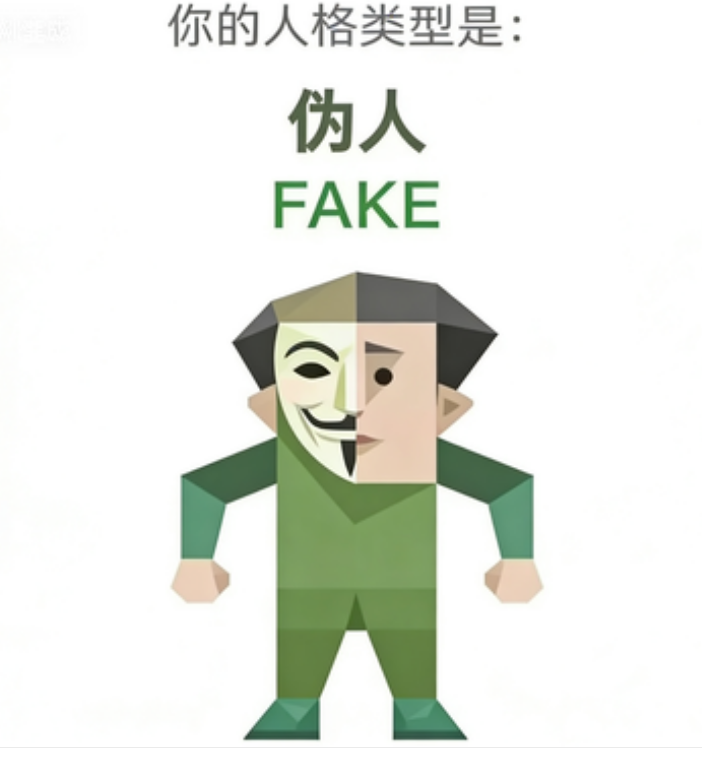
The Mask Shifter · 伪人
You adapt so quickly that even you may forget which layer is the original one.
FAKE types are socially adaptive, observant, and skilled at code-switching. You can fit many rooms, but staying visible to yourself is the harder part.
Want to see your own result? Take the free SBTI test — it only takes a few minutes.
Take the testEach normal type is defined by a 15-dimension pattern. The cards below show the baseline temperament behind this result.
You usually keep a steady sense of self-worth even when life gets noisy.
You often feel blurry about who you really are.
You switch between striving and lying flat depending on timing.
You swing between trust and caution depending on the situation.
You can invest deeply, but you still keep one hand on the brake.
Closeness and emotional temperature matter a lot to you.
You are neither naive nor fully cynical; you observe first.
Freedom and comfort often beat rules in your personal ranking.
Your sense of purpose comes and goes in waves.
Sometimes you want to win; sometimes you just want no trouble.
You can loop for a long time before making a call.
You can execute, but your consistency depends on timing and mood.
You are fairly willing to open the conversation or set the tone.
You tend to pull trusted people close into your inner circle.
You are good at switching versions of yourself for different rooms.
The most common questions people search for about the SBTI FAKE type.
FAKE types are socially adaptive, observant, and skilled at code-switching. You can fit many rooms, but staying visible to yourself is the harder part.
You adapt so quickly that even you may forget which layer is the original one.
Take the free 31-question SBTI test on this site. The algorithm scores your answers across 15 behavioral dimensions and matches your profile against every named type. If FAKE is your closest match, it becomes your result.
SBTI does not publish official distribution data, so there is no verified answer on how rare FAKE is. What matters is that every named SBTI type — including FAKE — describes a real and distinct behavioral pattern. No result is objectively better, worse, or rarer than another.