
S1 Self-esteem
L
You are harsh on yourself and rarely believe praise on the first try.
SBTI Type
The Self-Doubter · 傻者
Inside you, impulse and self-criticism are locked in a cage match.
IMSB types feel big urges and big hesitation at the same time. You are not actually stupid; you just experience desire and self-doubt at full volume.
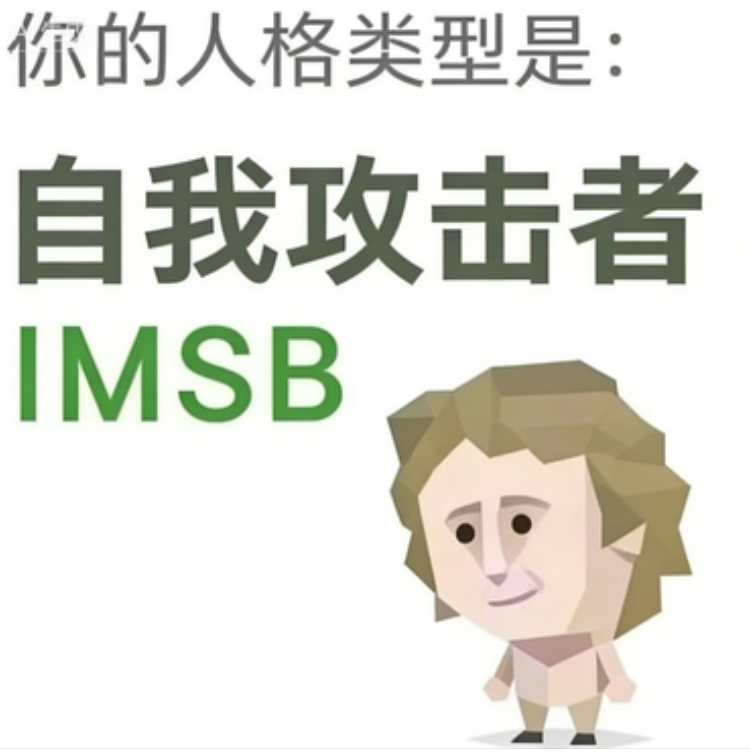
Want to see your own result? Take the free SBTI test — it only takes a few minutes.
Take the testEach normal type is defined by a 15-dimension pattern. The cards below show the baseline temperament behind this result.
You are harsh on yourself and rarely believe praise on the first try.
You often feel blurry about who you really are.
You switch between striving and lying flat depending on timing.
Your internal alarm goes off fast in close relationships.
You can invest deeply, but you still keep one hand on the brake.
You want both intimacy and space, and keep rebalancing them.
Your default mode is suspicion first, warmth later.
Freedom and comfort often beat rules in your personal ranking.
A lot of life can feel like a routine you are only half buying into.
You check for danger before you chase rewards.
You can loop for a long time before making a call.
Deadlines have a magical way of resurrecting your execution power.
You are socially flexible, but you do not force the moment.
You tend to pull trusted people close into your inner circle.
You try to balance honesty with atmosphere and context.
The most common questions people search for about the SBTI IMSB type.
IMSB types feel big urges and big hesitation at the same time. You are not actually stupid; you just experience desire and self-doubt at full volume.
Inside you, impulse and self-criticism are locked in a cage match.
Take the free 31-question SBTI test on this site. The algorithm scores your answers across 15 behavioral dimensions and matches your profile against every named type. If IMSB is your closest match, it becomes your result.
SBTI does not publish official distribution data, so there is no verified answer on how rare IMSB is. What matters is that every named SBTI type — including IMSB — describes a real and distinct behavioral pattern. No result is objectively better, worse, or rarer than another.